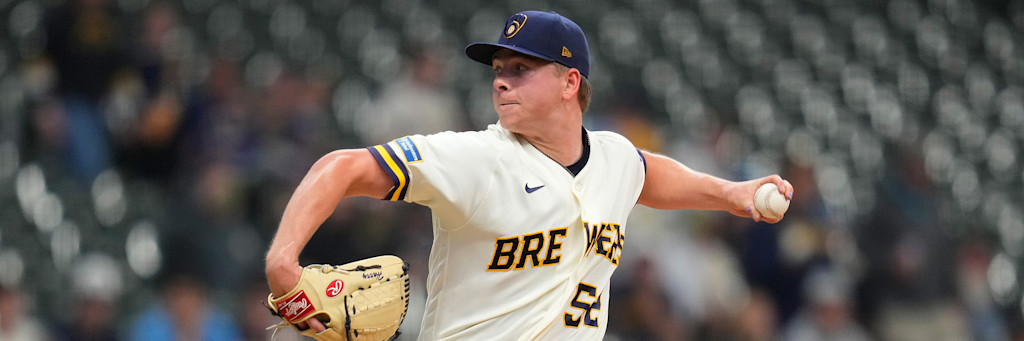
The outs-recorded prop is the most honest pitching market on the board, because it strips a start down to a single question with no run support, no defense, and no bullpen to muddy it: how deep does the manager let him go. For Kyle Harrison the answer is trending in one direction, and the projection model reads his line of 16.5 outs as a number set a half-tick beneath where his last month of work actually lives. The play is Harrison over 16.5 outs recorded at -106 for 2.5 units, and the case is a distribution argument, not a hunch.
Verified Game And Pitcher Inputs
| Input | Value | Source window |
|---|---|---|
| Harrison 2026 ERA | 1.57 | 11 starts, 57.1 IP |
| Harrison K/9 | 11.46 | 73 strikeouts |
| Harrison WHIP | 1.03 | season |
| Outs per start | 15.6 average, 16 median | 11-start log |
| Opponent | Athletics (31-34) | Jeffrey Springs, RHP-counter |
Harrison takes the ball for Milwaukee against Jeffrey Springs and the Athletics. The single variable this ticket prices is Harrison's own workload, expressed as outs, and everything downstream of that, the run total, the moneyline, the team total, lives in a different market. We are projecting one number: how many of the twenty-seven outs Harrison personally records before the hook.
The Distribution Is The Whole Argument
Here is the start-by-start outs log that the model is built on, in order across his eleven 2026 starts: 15, 16, 13, 9, 18, 18, 12, 15, 21, 18, 17. The mean is 15.6 and the median is 16, which is exactly why this line is shaded to 16.5 rather than a round 17. But a mean flattens the most important feature of the data, which is the slope. Look at the last five starts in isolation: 15, 21, 18, and 17 outs across his four most recent dated outings, with the 12-out clunker sitting back in mid-May. Three of his last five clear 17 outs. The over does not need the season; it needs the pitcher Harrison has been since late May, and the recent distribution sits a full out or more above the line.
Why Elite Run Prevention Buys Length
Dig one layer down and you reach the relationship between dominance and depth. A starter at a 1.57 ERA with a 1.03 WHIP is, by definition, not putting traffic on the bases, and the cleanest path to a short start is the opposite, the death-by-walk inning that spikes a pitch count. Harrison is missing bats at 11.46 per nine, and strikeouts are pitch-count expensive but rally-cheap, which means his innings tend to be clean rather than grueling. A manager watching a sub-2.00 arm cruise has every structural incentive to push him to the 18th and 21st out, because the alternative is exposing a bullpen earlier in a game his ace is controlling. Elite run prevention and start length are correlated for a reason, and Harrison sits at the front of both distributions.
The Opponent Profile Supports The Push
Across the field, the Athletics are a 31-34 club hitting .244 as a team with a .324 on-base mark, a middle-tier offense without the high-walk profile that drives starters out early. Against a strikeout arm, a contact-leaning lineup that does not grind deep counts is the friendliest possible matchup for a length prop, because outs come fast and pitch counts stay manageable. Springs on the other side is a competent lefty-style innings-eater with a 4.37 ERA, which matters only insofar as it keeps Milwaukee from blowing the game open early and pulling Harrison for a position-player mop-up, a scenario that almost never befalls the favorite's ace in a competitive game anyway.
The Three Signals That Converge
Conviction here leans on three independent inputs pointing the same way. First, the recent outs distribution: three of the last five starts at 17 or more, with a clear upward slope off the May 14 floor. Second, the run-prevention profile: a 1.03 WHIP and 11.46 K/9 are the fingerprints of clean, push-able innings rather than laborious ones. Third, the opponent: a contact-oriented .244-hitting Athletics lineup that does not lengthen at-bats the way a high-walk club would. When recent form, pitcher profile, and matchup all agree, the line at 16.5 reads low.
Reading The Price And Sizing The Stake
At -106 the break-even probability is roughly 51.5 percent, which is the friendliest part of this ticket. The model does not need a heroic hit rate to clear that bar, just a coin flip with a thumb on the scale, and the recent distribution plus the profile supplies the thumb. The stake is 2.5 units rather than a flagship number for one disciplined reason explained in the next section: the season average sits below the line, so this is a recent-form projection, and an honest model sizes to the width of the gap between recent and aggregate, not to the size of the dream.
The Filter That Sized It Down
One process note, in the spirit of showing the work. The model weights the trailing five starts heavily, but it does not discard the full season, and the full season says Harrison averages 15.6 outs with a median of 16, both at or below the 16.5 line. That tension is real and it is why this is not a four-unit play. The over is buying the slope, the recent three-of-five at 17-plus, and the structural case that a 1.57-ERA arm gets pushed, while respecting that the central tendency of the larger sample sits right on the number. Stakes scale with the depth of the projected gap, and a modest, recent-form edge earns the 2.5 units it is sized at, no more.
The Other Three On The Slate
That same Brewers club anchors the night's moneyline lean. Milwaukee is 40-23, the best record on the slate, riding a three-game winning streak, and at -137 against a 31-34 Athletics team with Harrison on the mound, the favorite price is well supported. Stack the other side of his start and you get the Athletics team total under 4.5 at +100: even money against a 1.03-WHIP arm missing bats at 11.46 per nine, opposing a streaky Athletics offense that scored one and two runs in back-to-back games this week. And in San Francisco, the Giants moneyline at -140 reads as a pitching mismatch the standings disguise, with Logan Webb, fresh off a seven-inning, one-hit shutout-caliber June 3 start, facing Miles Mikolas and his 6.39 ERA.
The Honest Counterpoint
Risks here are specific and worth stating without spin. A season average of 15.6 outs sits below the line, so the model is betting the recent curve continues rather than reverts, and a single rough first inning, a long at-bat sequence, or an early lead that lets Milwaukee rest him can cap a start at 15 outs the way his May 14 outing did at 12. Pitch-count hooks are also a manager's prerogative, and a young arm on a contender can get a conservative leash on a given night regardless of effectiveness. The Athletics' lineup was not confirmed at publication, so the projection assumes a standard contact profile. This is a slope bet on a thin line, which is exactly why it is sized below the flagship plays.
What Beats It
A short leash beats this ticket. If Harrison labors through a 25-pitch first, or if Milwaukee builds an early cushion and the staff opts to bank his bullets for the next turn, the under cashes on a 15-out night that says nothing bad about the pitcher. The May 14 start at 12 outs is the live floor. The over leans on the slope of his last five starts holding and on a competitive game keeping the ace on the mound into the sixth.
Final Verdict
The model play is Kyle Harrison over 16.5 outs recorded at -106 for 2.5 units. The edge is a recent outs distribution of 21, 18, and 17 in three of his last five starts, a 1.03 WHIP and 11.46 K/9 that fingerprint clean and push-able innings, and a contact-oriented Athletics lineup that lets a strikeout arm work fast. The line is set at the season median; the projection is built on the trailing month. For more from the model, see the prediction archive, the latest projections, and the homepage board.
Picks and odds come from the BetLegend daily tracker. Probable starters, records, season rates, recent run totals, and starter game logs were verified against MLB Stats API data for June 8, 2026.