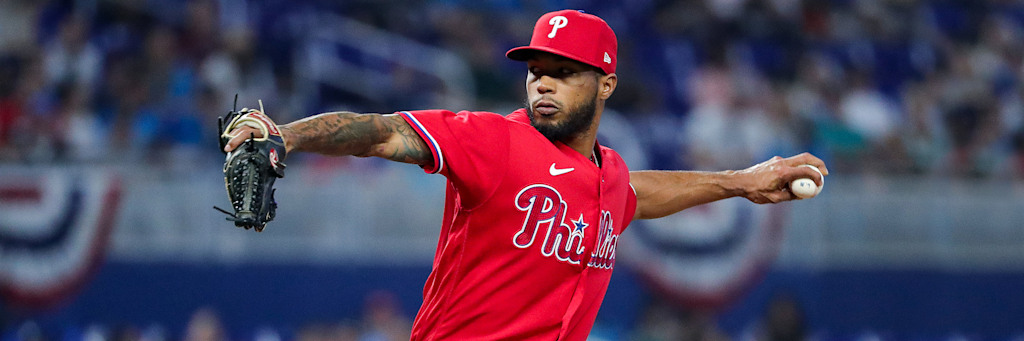
Run expectancy is a per-plate-appearance way of asking a single question: given the base-out state and the quality of the arm on the mound, how many runs should we project this lineup to score. A team total is the cleanest place to apply it, because it isolates one offense against one pitching staff and strips out the second team entirely. On a Sunday board this thick with quality starters, the model returns its sharpest read on the Brewers team total under 3.5 at -150, and the input driving it is the best pitcher in baseball this season.
Cristopher Sanchez carries a 1.54 ERA, a 1.06 WHIP, and 113 strikeouts across 93.1 innings in 14 starts, and the model does not need to regress those numbers far to flag the matchup. His changeup is a swing-and-miss weapon that suppresses both the walk and the extra-base hit, the two events that inflate a run-expectancy curve fastest. Milwaukee scores 5.38 runs a game at full strength, but a high-volume bat-misser collapses the right tail of that distribution, and the model's median projection for the Brewers lands under the number.
Why The Brewers Under 3.5 Is The Model's Top Read
Whiff rate is the mechanism here. When a starter misses bats at Sanchez's clip, the probability of the multi-run inning, the event that carries any team total over its line, drops sharply because fewer balls are put in play to begin with. A walk-and-extra-base-hit suppressor turns a 5.38-runs-a-game offense into something closer to three projected runs against him specifically. The -150 price implies a break-even near 60 percent, and the model's projected probability of the Brewers staying at or under three runs clears it, which is why this rates as the top stake at 2 units rather than a lean.
The Phillies send Sanchez and the Brewers counter with Kyle Harrison, who carries his own 2.72 ERA and 77 strikeouts in 59.2 innings, which is why the full-game Phillies-Brewers under 6.5 is the lowest total on the slate. Two strikeout arms on the same line is the textbook setup for a compressed game distribution, but the team total is the higher-conviction expression because it isolates the single variable, Milwaukee's bats against Sanchez, that the model is most certain about.
Skenes And The Marlins Run-Suppression Projection
A near-mirror of the Brewers projection sits one rung down: the Marlins team total under 3.5 at -140 is the second-strongest read. Paul Skenes brings a 2.84 ERA, a 0.93 WHIP, and 89 strikeouts across 76 innings to PNC Park, and the WHIP is the input the model weights heaviest. A sub-0.95 WHIP means fewer than a baserunner per inning, which starves a run-expectancy model of the base-out states that produce runs in the first place. Miami enters at a .246 average and a .705 OPS, a contact-dependent profile that whiff-heavy arms erase, and the projected Marlins run total lands comfortably below 3.5.
| Play | Line | Implied break-even | Model lean |
|---|---|---|---|
| Brewers team total under 3.5 | -150 | ~60.0% | Under, Sanchez 1.06 WHIP, 113 K |
| Marlins team total under 3.5 | -140 | ~58.3% | Under, Skenes 0.93 WHIP |
| Cubs team total under 3.5 | -110 | ~52.4% | Under, Webb plus Oracle factor |
| Mariners ML at Washington | -129 | ~56.3% | Seattle, Hancock 0.95 WHIP |
The Cubs Under As A Park-Adjusted Projection
The Cubs team total under 3.5 at -110 is where park factor does as much work as the arm. Logan Webb sits at a 3.88 ERA and a 1.19 WHIP, a steady ground-ball profile rather than a strikeout monster, but he pitches at Oracle Park, one of the most run-suppressing venues in the league. The deep right-center gap and the cool evening marine air measurably shorten fly-ball distance, and a park-adjusted run-expectancy model treats that environment as a multiplier on the suppression. Chicago scores 4.62 runs a game, the liveliest of the offenses the model is fading here, which is precisely why the price is only -110: the bats are a notch better, but the venue and Webb's contact management offset it, and the projection still clears the break-even.
The Mariners Moneyline And A 0.95 WHIP Input
Not every projection points at a total. The Seattle Mariners moneyline at -129 is a starter-driven win-probability read, and the input is Emerson Hancock. He carries a 2.74 ERA, a 0.95 WHIP, and 73 strikeouts across 75.2 innings in 13 starts, and his baserunner suppression is the component that dominates the model's win-probability calculation against Washington and PJ Poulin. Seattle's offense is modest at 4.31 runs a game, but the lineup owns 94 home runs, enough power variance to manufacture a low-scoring win, and Hancock's run prevention gives that thin offense the margin it needs. The -129 price implies roughly a 56.3 percent break-even, and the projected win probability clears it by enough to justify 2 units, even with near-even records of 37-35 and 36-35.
Verified Model Inputs
| Game | Records | Starter inputs |
|---|---|---|
| Marlins at Pirates | MIA 35-36 / PIT 36-35 | Meyer 2.85 ERA / Skenes 2.84 ERA, 0.93 WHIP |
| Phillies at Brewers | PHI 38-32 / MIL 42-26 | Sanchez 1.54 ERA, 1.06 WHIP / Harrison 2.72 ERA |
| Cubs at Giants | CHC 37-34 / SF 28-43 | Rolison / Webb 3.88 ERA, 1.19 WHIP |
| Mariners at Nationals | SEA 37-35 / WSH 36-35 | Hancock 2.74 ERA, 0.95 WHIP / Poulin |
The Honest Counterpoint
A projection model outputs a distribution, not a verdict, and the tail risk on every under here is real. Team-total distributions are right-skewed, which means one three-run inning carries a number even when the median projection sits comfortably below it. A quick hook on any of these aces hands the game to a bullpen the model never projected, and the under built on the starter evaporates. The Mariners moneyline asks the model to be right about a road favorite in a near-even record matchup, where a strong Poulin start collapses the edge inside a single game of variance. Hancock's 0.95 WHIP is elite, but his strikeout volume is moderate, so balls in play finding grass carry more weight than they would behind a higher-whiff arm. Calibration is measured over a season, not validated on one Sunday.
How The Model Sizes The Card
Stake tracks the gap between projected probability and implied break-even. The Brewers under shows the widest gap on the strength of Sanchez's whiff rate, so it carries the heaviest weight. The Marlins under follows closely behind on Skenes' WHIP. The Cubs under takes a lighter stake at a friendlier price because a livelier offense narrows the edge even with the Oracle Park multiplier. The Mariners moneyline takes 2 units as the lone side, a starter-driven win-probability read. The sizing is the model talking, not a feeling, and the card reads as a measured run-suppression slate rather than a high-variance swing.
What Beats It
A single crooked inning beats any team-total under, because the distribution is dominated by the rare multi-run frame the median projection does not expect. A clean start from Poulin and a quiet Seattle bat flips the Mariners projection inside the variance band. A Cubs lineup that travels well and a flat Webb outing sinks the park-driven lean. The model is favored on each leg, but favored is never certain, and a calibrated projection expects to lose a real share of bets it is correctly priced to win.
Final Verdict
The Sunday model leads with the Brewers team total under 3.5 at -150 behind Cristopher Sanchez and a 1.54 ERA, follows with the Marlins team total under 3.5 at -140 on Skenes' 0.93 WHIP, adds the Cubs team total under 3.5 at -110 as the park-adjusted lean, and closes with the Mariners moneyline at -129 for 2 units on Hancock's run suppression. For more projection work from this stretch, see our June 12 run-expectancy model card, our Braves win-probability read on WHIP and run differential, and the full projection archive for how these inputs have calibrated.