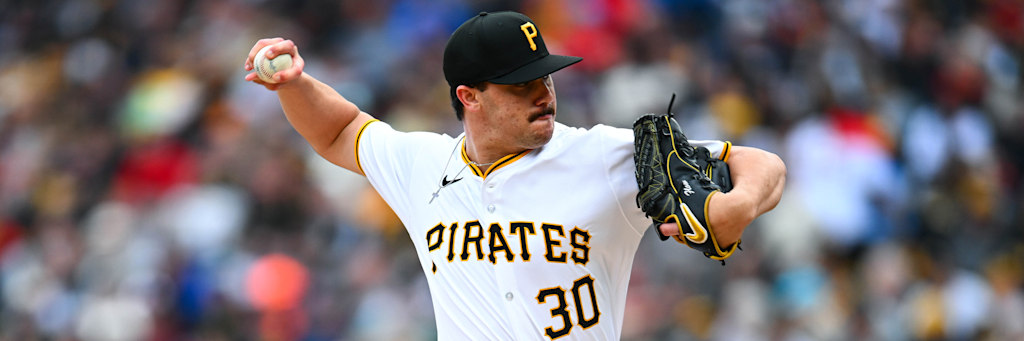
The cleanest edges a run-prevention model finds are not in the games everyone is watching, they are in the team-total markets where one starter's distribution is extreme enough to override both the lineup and the park. The June 20 board hands the model three of them. The headline output is the most counterintuitive: a Rockies team total under 4.5 at -152 at Coors Field, the most run-friendly environment in the sport, for 3 units. Behind it sit the Orioles team total under 3.5 at -140 against Yoshinobu Yamamoto for 2.5 units and the Brewers versus Braves first five innings under 3.5 at -110 for 2.5 units. Each is a case where the suppression term in the projection beats the offensive baseline by enough to push the run distribution below the line.
The Framework: Why The Starter Term Dominates
A team total projection is a weighted sum of two distributions, the hitting club's baseline run rate and the opposing starter's run-suppression profile. For most games those terms roughly balance and the projection lands near the posted number, which means no edge. The exploitable games are the outliers, where a starter's strikeout rate and contact suppression are extreme enough to collapse the offensive baseline. The model is not betting that the Rockies cannot hit at Coors. It is betting that a specific pitcher, on this specific night, bends the run distribution far enough left that 4.5 sits in the tail rather than the center. The art is identifying when the pitcher term outweighs everything else, and June 20 has three such arms.
Rockies Team Total Under 4.5: The Skenes Variable At Coors
| Team | Probable starter | 2026 line | Record |
|---|---|---|---|
| Pirates | Paul Skenes (RHP) | 2.85 ERA, 1.02 WHIP, 99 K, 3.26 road ERA | 38-38 |
| Rockies | Tomoyuki Sugano (RHP) | 4.65 ERA, 1.42 WHIP | 29-47 |
The model's read at Coors is not a bet against altitude, it is a bet on the single most dominant strikeout arm taking the mound there. Skenes carries a 2.85 ERA and a 1.02 WHIP, and the number that matters most for this projection is his road ERA of 3.26, his road work is in line with his season, not a collapse away from PNC Park. A model fed Skenes against Colorado projects the Rockies' run output well below their home baseline of 4.6 runs per game, because his swing-and-miss rate removes the multi-batter sequences that altitude scoring depends on. Coors inflates runs by turning routine contact into damage and by enlarging the outfield gaps, but a strikeout is immune to both. The ball that never leaves the bat cannot find the gap or carry to the seats. That is why a sub-.400 Rockies club at 29-47 projects under 4.5 even at home, and why this is the board's largest stake.
Orioles Team Total Under 3.5: Yamamoto's WHIP Carries It
| Team | Probable starter | 2026 line | Record |
|---|---|---|---|
| Orioles | Trevor Rogers (LHP) | 5.86 ERA, 1.45 WHIP | 35-42 |
| Dodgers | Yoshinobu Yamamoto (RHP) | 2.84 ERA, 0.84 WHIP, 80 K | 49-27 |
The Orioles team total under is the cleanest WHIP-driven projection on the board. Yamamoto is carrying a 0.84 WHIP, second-lowest among qualified starters, alongside a 2.84 ERA. A WHIP under 0.9 is the single most predictive input for a team total under, because it directly measures the baserunner volume an offense gets to work with, and run scoring is overwhelmingly a function of baserunners times sequencing. Strip the baserunners and the sequencing has nothing to act on. Baltimore is a middling-to-poor offense at 35-42 generating 4.6 runs per game against league-average pitching, but the projection conditions that baseline on the actual arm they face. Against a starter allowing well under a baserunner an inning at Dodger Stadium, a pitcher-neutral park, the Orioles' projected run column lands comfortably under 3.5. The fact that Baltimore's own starter, Trevor Rogers, sports a 5.86 ERA does not touch this bet, because a team total tracks only the Orioles' bats, but it does explain why this is a team-total angle rather than a side.
Brewers Braves First Five Under 3.5: Two Aces, A Narrowed Window
| Team | Probable starter | 2026 line | Record |
|---|---|---|---|
| Brewers | Kyle Harrison (LHP) | 2.47 ERA, 8-1 | 45-28 |
| Braves | Chris Sale (LHP) | 2.30 ERA, 1.05 WHIP, 92 K | 47-27 |
The first-five-innings market is where the model isolates the part of the game it can project most precisely, the starters, and removes the part it cannot, the bullpens. This matchup is the textbook use case. Two of the best offenses in baseball meet, the Brewers at 5.27 runs per game and the Braves at 4.99, and a full-game total would be a coin flip clouded by relief volatility. But the first five innings belong almost entirely to Kyle Harrison, carrying a 2.47 ERA and an 8-1 record, and Chris Sale, at a 2.30 ERA with a 1.05 WHIP and 92 strikeouts. Both are left-handed strikeout arms who project to work through the order once or twice with the run distribution compressed. A 3.5 first-five total asks for three runs or fewer across both clubs through five innings. With two arms missing bats at this rate, the projected combined first-five output lands under the number, and the under sidesteps the late-inning chaos that two elite lineups would otherwise create.
Why First Five Beats The Full Game Here
The general principle worth keeping is this: bet the window your model can actually project. A full-game total folds in four to five innings of bullpen usage, pinch hitters, and leverage decisions that no pregame projection captures cleanly. When the edge lives in the starters, the first-five market lets you collect it without paying for the noise. Against two 5-plus-run offenses, a full-game under would be a fade of the lineups; the first-five under is instead a bet on two specific aces during the innings they control. That is a structurally sounder position, which is why the model carries it at the same 2.5 units as the Orioles spot even though the offenses are elite.
The Honest Counterpoint
Every projection has a failure mode, and these three are honest about theirs. The Rockies under is the boldest output on the board precisely because Coors can break any model, one rally that turns into a four-run inning through gaps and altitude carry, and Skenes is a road start away from PNC Park with a higher road ERA than home. The Orioles under leans on a single elite arm, and even a 0.84 WHIP pitcher surrenders the occasional two-run home run that clears a 3.5 number on its own. The first-five under asks two of the league's best offenses to stay quiet early, and elite lineups can post a three-spot in a single frame against anyone. The model still grades all three as edges because the suppression inputs, an elite strikeout arm at Coors, a sub-.9 WHIP at a neutral park, and two ace left-handers in the window they control, are extreme enough to outweigh the offensive baselines. A projection is a probability, not a promise.
Final Verdict
The June 20 run-prevention model outputs three team-total and first-five unders, each one a case where the starter's distribution beats the lineup and the park. The board is the Rockies team total under 4.5 at -152 for 3 units behind Paul Skenes at Coors, the Orioles team total under 3.5 at -140 for 2.5 units against Yamamoto's 0.84 WHIP, and the Brewers versus Braves first five innings under 3.5 at -110 for 2.5 units behind Harrison and Sale. For more on how the model weighs an ace against a hot lineup, see our June 18 run-prevention model on the Guardians Brewers under, and browse the full MLB Prediction archive for how these projections have landed.