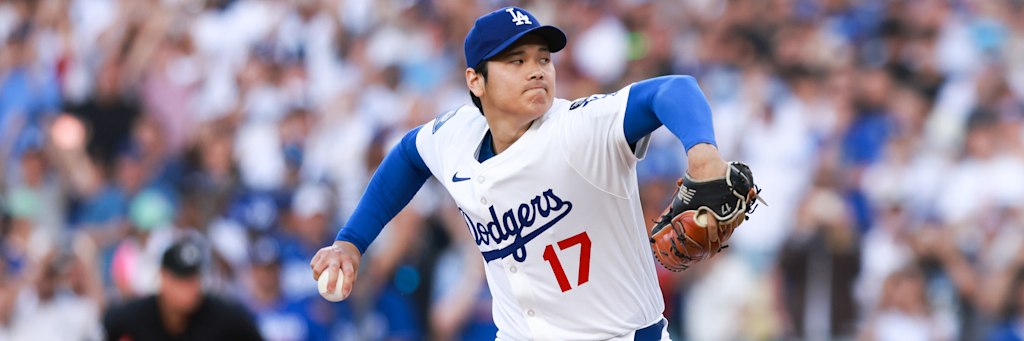
One pitching profile dominates the entire June 24 projection, and it belongs to Shohei Ohtani: a 1.47 ERA across 73.2 innings, 78 strikeouts, and a Statcast file that grades among the most extreme run-suppressors in the sport, a 28.8 percent strikeout rate and a 97.6 mph average fastball. Feed that arm into a run-expectancy model against a Minnesota offense sitting at 34-45 and the Twins team total under 3.5 becomes the single cleanest output on the board. The rest of the slate sorts around it on the same two axes: how often a starter misses bats, and how hard the contact he allows is hit.
The Framework: K Rate, Opponent Average And Park As Inputs
A run-projection model collapses to two probabilities: how often a plate appearance produces a baserunner, and how often baserunners convert to runs. Strikeout rate attacks the first directly, because the strikeout is the only batted-ball outcome with a run expectancy of zero. Opponent batting average and hard-hit rate attack the second, by measuring the damage a pitcher allows on the contact he permits. Park factor then scales the whole distribution up or down: Coors Field stretches it, while Target Field and Tropicana Field play closer to neutral. When a starter grades highly on K rate and contact suppression and the park does not fight him, the projected run column narrows and the edge against an inflated total or an underpriced moneyline widens. June 24 is dense with arms that clear those thresholds, which is why the model leans run-prevention across most of the slate.
Twins Team Total Under 3.5: The Ohtani Suppression Signal
| Team | Probable starter | Record |
|---|---|---|
| Dodgers | Shohei Ohtani (RHP, 7-2, 1.47 ERA, 78 K, 28.8% K rate, 97.6 mph FB) | 51-29 |
| Twins | Joe Ryan (RHP, 5-3, 2.99 ERA, 10.2 K/9, .211 BAA) | 34-45 |
Ohtani is the most important variable on the slate, and the Twins team total under 3.5 is the purest way to express his signal. A 1.47 ERA over 73.2 innings is not a small-sample mirage; it is backed by a 28.8 percent strikeout rate, meaning more than one in four Minnesota plate appearances projects to end without a ball in play. Strip those at-bats out of a lineup already scuffling at 34-45 and the projected run column collapses toward the low end of the distribution. A 3.5-run bar requires Minnesota to sustain multiple scoring innings against a starter who removes the high-leverage contact those innings depend on, and the model assigns that a probability comfortably below the implied break-even.
The honest model caveat is on the other side of the rubber. Joe Ryan was pushed back a day to take this start and is an excellent arm in his own right, a 2.99 ERA with a 10.2 strikeouts-per-nine rate and a .211 opponent average. His quality matters for the full-game total, which projects sharply down, but it does not change the Twins-only read: this is a bet on Minnesota's bats against Ohtani, and Ryan being good does not help the Twins score. The team total isolates exactly the variable the model is most confident about.
Orioles Team Total Under 4.5: Soriano As The Secondary Suppressor
| Team | Probable starter | Record |
|---|---|---|
| Angels | Jose Soriano (RHP, 8-4, 3.03 ERA) | 33-48 |
| Orioles | Trey Gibson (RHP, 1-2, 5.81 ERA) | 39-40 |
The Orioles team total under 4.5 is the same model output expressed against a quieter but still strong arm. Jose Soriano is 8-4 with a 3.03 ERA, a genuine run-suppressor, and Baltimore's middle-of-the-pack offense projects under 4.5 against him at Angel Stadium, a park that plays close to neutral and does not inflate the read. The model flags an important structural note here: Baltimore is actually the road favorite on the moneyline because Trey Gibson and his 5.81 ERA face a 33-48 Angels club, so the side of the game and the team total point in opposite directions. That is by design. The under does not need the Orioles to lose; it needs Soriano to cap their run column, and a 3.03 ERA against an average offense projects to do exactly that more often than not.
Guardians Moneyline: A Matchup-History Adjustment, Not A Mispriced Favorite
| Team | Probable starter | Record |
|---|---|---|
| Guardians | Tanner Bibee (RHP, 2-8, 4.03 ERA, 4-0 career vs CWS) | 41-39 |
| White Sox | Erick Fedde (RHP, 2-6, 4.46 ERA) | 41-37 |
The Guardians moneyline is the model's most carefully bounded position, and the framing matters. This is close to a pickem game, with the White Sox holding a narrow home-favorite price and a one-game American League Central lead, so the model does not treat Cleveland as a mispriced road chalk. The edge is a matchup-history adjustment layered onto two similar season lines: Bibee at a 4.03 ERA versus Fedde at 4.46. Bibee owns a 4-0 career record against this White Sox lineup, the kind of opponent-specific signal a base-rate model under-weights and a sharper read folds in. With the prices near even and the season profiles a near wash, the matchup history is enough to nudge the projection to Cleveland, but only enough to make it a small-conviction play rather than a sized one.
Rays, Blue Jays And Red Sox Moneylines: The Rotation-Edge Layer
Three more sides clear the model's favorite threshold on rotation edge, each at a different conviction level.
| Play | Line | The projection signal |
|---|---|---|
| Rays ML | -145 | Griffin Jax (3.67 ERA) over Noah Cameron (4.20), 43-33 home club vs 34-46 road club |
| Blue Jays ML | -155 | Trey Yesavage (3.76 ERA) over Mike Burrows (5.79), home rotation edge |
| Red Sox ML | -165 | Ranger Suarez (2.93 ERA) over Kyle Freeland (7.36) at Coors, side only |
The Rays moneyline is the model's highest-conviction side. Griffin Jax projects ahead of Noah Cameron on ERA, 3.67 to 4.20, and the team gap is even larger: a 43-33 Tampa Bay club hosting a 34-46 Kansas City team. The win-probability output clears the -145 break-even of 59.2 percent with room to spare, because the projection stacks the better arm, the better roster and the home park on the same side. The Blue Jays at -155 are a clean rotation-edge favorite, Yesavage's 3.76 ERA against Burrows at 5.79, though Burrows missing bats with 66 strikeouts widens the variance band enough to keep it a notch below the Rays.
The Red Sox moneyline is the model's clearest example of why park factor is an input on the run distribution but not on the win probability. Ranger Suarez at a 2.93 ERA projects far ahead of Kyle Freeland at 7.36, and that edge on who wins survives Coors Field intact. The altitude widens the run total dramatically, which is why the model flags the Coors total as un-bettable, but the moneyline only asks which club is better, and a four-and-a-half-run ERA gap does not shrink at elevation. Bet the side, not the total.
The Two Overs: When The Model Flips To Run Expansion
| Play | Line | The run-expansion signal |
|---|---|---|
| Phillies/Nationals Over | 9.5 | Aaron Nola (5.71 ERA) vs Miles Mikolas (5.47), both above 5.40 |
| Braves/Padres Over | 7.5 | Two contending offenses at Petco against mid-tier arms |
The same framework that produces unders produces overs when the inputs invert. The Phillies and Nationals over 9.5 is the cleanest example: Aaron Nola at a 5.71 ERA and Miles Mikolas at 5.47 are both allowing runs at a rate that pushes the projected run environment above the line before either bullpen enters. Two starters living north of a 5.40 ERA describe a game where contact converts to runs at an elevated clip, and the model projects the combined total over 9.5. The Braves and Padres over 7.5 is the softer of the two because Martin Perez at 2.78 and Randy Vasquez at 4.17 are sturdier arms, so the case shifts from weak pitching to strong offense: Atlanta at 48-30 and San Diego at 41-37 are both run-producing clubs, and 7.5 is a modest bar for two contenders across nine innings. The model rates it up, but as a lean rather than a hammer.
Where The Model Is Most Exposed
Every projection has a failure mode the model prices but cannot eliminate. The Twins under loses if Ohtani exits early and the Dodgers bullpen hands Minnesota innings, since relief work is harder to project than an ace's start. The Orioles under busts if Baltimore strings together a contact-heavy inning before Soriano settles. The Guardians moneyline is a near-pickem, so the matchup-history edge is thin by design and a single Fedde gem flips it. The Rays, Blue Jays and Red Sox sides each carry the standard favorite risk of one bad inning from the better arm, and the Red Sox in particular sit in a park that magnifies any wobble. The two overs lose if the better starters, Perez especially, throw quiet games. A favored projection is a probability, not a promise, and a board this size will not resolve in the model's favor every night.
The Model Verdict
The June 24 projection is anchored by run-prevention, and the highest-confidence outputs are the Twins team total under 3.5 behind Ohtani's 1.47 ERA and 28.8 percent strikeout rate, and the Rays ML -145 on a stacked rotation, roster and park edge. The Orioles team total under 4.5 rides Soriano's 3.03 ERA, the Blue Jays and Red Sox moneylines are rotation-edge sides, the Guardians ML is a bounded matchup-history lean, and the Phillies/Nationals Over 9.5 and Braves/Padres Over 7.5 are the run-expansion reads where the inputs flip. For more model breakdowns, see the latest projection and the full model archive.