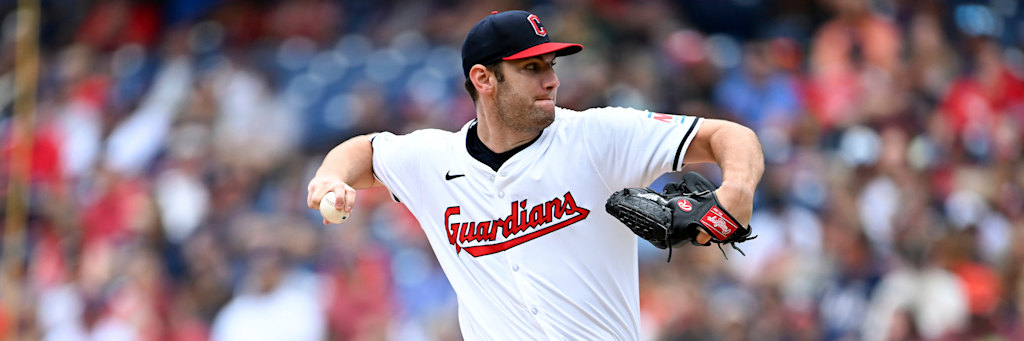
One number anchors the entire June 22 projection, and it belongs to Gavin Williams: a 27.9 percent strikeout rate paired with a .220 opponent batting average. Those two figures describe a starter who removes more than a quarter of the plate appearances he faces from the run-scoring distribution entirely, and who suppresses damage on the contact that remains. Feed that into a game-total model and the Guardians versus White Sox under 8 emerges as the cleanest output on the board, which is why it carries the heaviest stake at 1.5 units.
The Framework: Strikeout Rate As The Dominant Total Input
A run-projection model reduces, at its core, to two probabilities: how often a plate appearance produces a baserunner, and how often baserunners convert to runs. Strikeout rate attacks the first term directly, because a strikeout is the one batted-ball outcome with a run expectancy of zero. Contact-suppression metrics, opponent average and hard-hit rate, attack the second, by compressing the right tail of the run distribution on the balls that are put in play. When a starter grades highly on both, the projected run total narrows and the edge against an inflated market line widens. The June 22 board is dense with these arms, which is what pushes the model toward run prevention across most of the slate.
Guardians White Sox Under 8: The Williams Suppression Signal
| Team | Probable starter | Record |
|---|---|---|
| Guardians | Gavin Williams (RHP, 9-4, 3.83 ERA, 27.9% K, .220 BAA) | 41-37 |
| White Sox | Anthony Kay (LHP, 6-2, 4.61 ERA, 10th-percentile run value) | 39-37 |
Williams is the single most important variable in this total. A 27.9 percent strikeout rate sits comfortably in the upper tier of qualified starters, and the .220 batting average he has allowed confirms the contact he does permit is weak. Against a White Sox lineup at Rate Field, the model projects Chicago's run column well below its season baseline, because the strikeout rate erases the high-leverage at-bats where Chicago would otherwise manufacture runs. That is the bulk of the under's value, concentrated on one side of the run total.
Anthony Kay supplies the other half. He grades in the tenth percentile of the league in pitcher run value, a bottom-of-the-distribution mark, and he has surrendered 12 runs across his last 13 innings. Ordinarily a weak starter pulls a total toward the over, but the relevant variable for the Guardians run column is not Kay in isolation; it is whether Cleveland can convert against him before the bullpen takes over. The model's projection lands under 8 because the dominant Williams side caps Chicago harder than the soft Kay side lifts Cleveland, and the net is a suppressed combined total. A 1.5-unit stake reflects the width of that projected gap.
Astros Blue Jays Under 7: Two Elite Bat-Missing Arms
| Team | Probable starter | Record |
|---|---|---|
| Astros | Hunter Brown (RHP, 1-0, 1.10 ERA, 24 K in ~16 IP) | 37-42 |
| Blue Jays | Dylan Cease (RHP, 4-3, 2.71 ERA, 110 K, third in MLB) | 38-39 |
If Williams is the model's anchor, the Astros versus Blue Jays under 7 is its purest expression of the strikeout-rate framework, because both starters live at the top of the distribution. Hunter Brown returns to a 1.10 ERA with 24 strikeouts across roughly 16 innings, and Dylan Cease brings 110 strikeouts, the third-highest total in baseball, into the opposite dugout. When both arms in a matchup miss bats at an elite rate, the projected combined run total collapses, because the strikeout-rate input is applied to both lineups at once and the model removes outcomes from each side of the ledger simultaneously.
The market has set this total at 7 with the under priced at plus money, +105, which the projection reads as a pricing inefficiency. A plus-money under in a matchup of two top-tier strikeout arms is the model paying you to take the side it already favors. The stake is held at 1 unit rather than higher because a game total carries more variance than a team total; a nine-inning run distribution has a fatter tail than a single club's run column, and the lighter stake hedges that spread even when the directional read is strong.
Brewers And Yankees Win Probability: Team-Quality Differentials
Two of the board's outputs are win-probability edges rather than totals, and both rest on roster-quality gaps the model weights independently of any starter's win-loss record. Milwaukee enters at 46-29, the best record in the National League, facing Cincinnati's Brady Singer, whose 5.32 ERA is underwritten by a 6.15 FIP. That FIP-above-ERA divergence is a regression flag: it indicates Singer has outrun his peripheral profile and the model projects his results to deteriorate toward the worse number. The Brewers moneyline at the listed price clears its implied threshold on the strength of the roster gap and the Singer regression signal.
New York's win-probability output is similarly clean. The Yankees sit at 46-30 against a Detroit club at 33-44, a 13-game differential in the standings, with Gerrit Cole carrying a 2.57 ERA into his sixth start of a post-surgery ramp. The model does not weight Cole's modest win-loss line; it weights the team-quality differential, the bullpen depth, and the contact-suppression profile Cole has shown across his return. All three point toward New York. Both win-probability plays carry 1.5-unit stakes, the size the model assigns to low-variance moneylines where a first-place roster faces a sub-.500 opponent.
The Full Projection Board
Beyond the four headline outputs, the model touches the remaining games on the slate, each sized by the width of its projected edge and the variance of the bet type.
| Projection | Line | Units | Primary input |
|---|---|---|---|
| Guardians/White Sox game total under | 8 (-120) | 1.5 | Williams 27.9% strikeout rate, .220 BAA |
| Brewers moneyline | -144 | 1.5 | NL-best roster, Singer 6.15 FIP regression |
| Yankees moneyline | -121 | 1.5 | 13-game standings gap, Cole contact suppression |
| Rays moneyline | -179 | 1.5 | Rasmussen 2.59 ERA, park run-suppression factor |
| Astros/Blue Jays game total under | 7 (+105) | 1.0 | Two elite paired strikeout starters at Rogers Centre |
| Braves/Padres game total under | 7.5 (-120) | 1.0 | Petco Park run-suppression factor |
| Red Sox team total under | 6.5 (-130) | 1.0 | Below-baseline Boston run rate, Coors-adjusted line |
The Rays moneyline at -179 is a win-probability output where the dominant input is Drew Rasmussen's 2.59 ERA paired with the run-suppression factor of Tropicana Field. The relevant counterweight is recency: Kansas City scored 30 runs across its last three games, which the unsophisticated model treats as predictive. A properly specified projection regresses that outburst heavily, because three games is a small sample against the larger base rate of an offense facing a sub-2.60 arm in a pitcher's park. The model holds the win-probability projection above the 64.2 percent break-even implied by -179.
The Coors Field Adjustment On The Red Sox Total
The Red Sox team total under 6.5 is the board's most park-dependent projection. Boston plays at Coors Field, the highest run-environment park in the model's factor table, which is precisely why the team-total line is set at 6.5 rather than the 4.5 a neutral venue would produce. The altitude adjustment is already embedded in the number. The projection's task is to evaluate whether this specific Boston lineup, sitting at 31-44 with an inconsistent run rate, clears six runs against Ryan Feltner, and the model's distribution places the median Boston output below the line even after the Coors inflation is applied. A 1-unit stake reflects the elevated variance a hitter's park introduces.
How The Model Sizes Each Output
Stake size is a function of two inputs: the gap between the projection and the market line, and the variance of the bet type. Team totals and single-game moneylines against weaker opponents are the lowest-variance outputs, which is why the Guardians under and the three moneylines carry 1.5-unit stakes. Game totals sit higher on the variance curve because a full-game run distribution has a fatter tail, so the Astros/Blue Jays and Braves/Padres unders hold at 1 unit even where the directional read is strong. The Red Sox team total carries a 1-unit stake despite being a contained bet, because the Coors environment widens its distribution beyond the typical team-total spread.
The Honest Counterpoint
A projection is a distribution, not a verdict, and the model names its own failure modes. The Williams-anchored under depends on him holding his strikeout rate; a short outing that hands Chicago the Cleveland bullpen early widens the combined total past 8. The Astros/Blue Jays under leans on both Brown and Cease sustaining elite bat-missing, and one early exit collapses the read. The Brewers moneyline inherits the variance of Woodruff making his first start back off the injured list, a leash spot the model accounts for in the stake. Lineups were not all confirmed at publication, so the projections assume listed regulars. A framework that respects variance sizes for it, which is the entire purpose of the unit structure.
What Beats It
A single multi-run inning beats the run-prevention board. The projection assumes the starters hold their strikeout and contact-suppression profiles; the night a top arm leaves early, both the team total and the game total come under pressure at once. The win-probability moneylines fall to quiet offenses or a starter clunker at a minus price with no plus-money cushion. The model is favored on its outputs, but favored is a probability, not a result, and the Coors-adjusted Red Sox total is the most exposed line on the slate.
Final Verdict
The June 22 projection model outputs the Guardians White Sox under 8 for 1.5 units as its anchor, the Brewers and Yankees moneylines for 1.5 units each, the Rays moneyline for 1.5 units, and the Astros Blue Jays under 7 for 1 unit as its sharpest plus-money total. The throughline is run prevention read through starter strikeout rate and contact suppression, with the Petco and Coors park factors the lone environmental adjustments. For more model work, see the advanced stats hub, the latest projections, and the prediction archive.
Picks and odds come from the BetLegend daily tracker. Probable starters, records, matchups, and venues were verified against MLB Stats API and ESPN data for June 22, 2026.