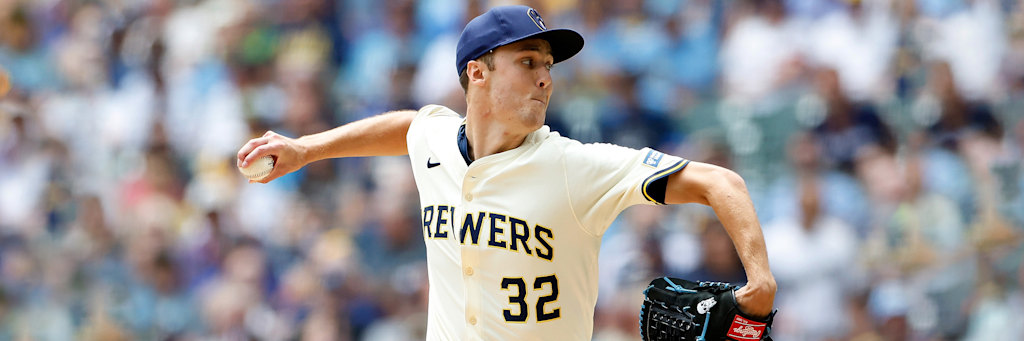
One pitching line on the Friday board sits outside the normal range of inputs the model weights, and it reshapes the entire projection. Jacob Misiorowski takes the mound for Milwaukee carrying a 1.45 ERA, a 0.75 WHIP and 138 strikeouts across 93 innings, and all three rank first in baseball. When a starter suppresses baserunners at that rate, the cleanest output is not the side but the team total attached to the offense standing in against him. The anchor projection is the Cubs team total under 2.5, with a Padres under 3.5 at Petco and a Mariners Guardians under 7.5 filling out a board built on run prevention.
The Framework: Strikeout Rate, WHIP And Park As Suppression Inputs
A team-total projection reduces to one question: how many runs can a single offense plausibly manufacture against a single starter and the bullpen behind him. Three inputs answer most of it. Strikeout rate caps the ceiling, because a strikeout carries a run expectancy of zero and erases both the productive out and the rally-extending contact. WHIP measures the baserunner supply, since runs are a function of traffic and an arm that keeps the bases empty starves an offense of the sequences that build crooked numbers. Park factor adjusts the whole distribution, raising or lowering the run environment before a pitch is thrown. The Friday board offers a starter who grades historically on the first two inputs and two more games where the park does the supporting work, and that overlap pushes the model to the team-total unders ahead of any moneyline.
Cubs Team Total Under 2.5: The Misiorowski Signal
| Team | Probable starter | Key inputs |
|---|---|---|
| Brewers | Jacob Misiorowski (RHP, 8-3, 1.45 ERA, 0.75 WHIP, 138 K) | League-best ERA, WHIP and strikeouts |
| Cubs offense | Chicago, 44-37 entering the day | Above-average bats facing the slate's top arm |
Misiorowski is the most extreme variable on the slate, and the model treats the Cubs team total under 2.5 as its highest-conviction output for a reason rooted in his WHIP. A 0.75 mark means he allows roughly three baserunners every four innings, which is the rate at which even a quality offense almost never strings together the multi-hit sequences a team total of 2.5 demands. Chicago is a respectable 44-37 club with real bats, so this is not a projection built on a weak opponent, it is built entirely on the arm. A team total isolates the exact run column Misiorowski most directly controls and strips out the noise of how many runs Milwaukee scores on the other side, which is why a sub-1.00 WHIP behind league-best strikeout stuff lands the Cubs projection in the low twos.
The model does not ignore the counterweight. The Cubs are a strong lineup that can ambush even an elite starter with one swing, and a team total set at 2.5 is razor thin, so a single early home run plus a sacrifice fly clears it before the bullpen ever appears. Misiorowski has also been worked hard in recent outings, and an early exit hands innings to relievers who do not share his profile. That is the chief failure mode. But the projection question is narrow: can an above-average offense reach three runs against the best WHIP in the sport before the night turns over. The median says no, and the 2.5 line reflects how cleanly the model reads it.
Padres Team Total Under 3.5: A Petco Read On A Turnaround Arm
| Team | Probable starter | Key inputs |
|---|---|---|
| Dodgers | Roki Sasaki (RHP, 3-4, 4.76 ERA, trending down) | Recent starts under three runs, deep bullpen behind him |
| Padres offense | San Diego, 42-37, hosting at Petco Park | Average run production in a strong pitcher's park |
The Padres under 3.5 is the model's park-driven output, and it requires more nuance than the Cubs projection because the starter's season line is misleading. Roki Sasaki's 4.76 ERA reads like a soft number, but the model weights recent form heavily, and his last several starts have come in well under three runs as his command has stabilized. Layer that improving arm on top of Petco Park, one of the most run-suppressing venues in the sport, and add a deep Los Angeles bullpen that inherits any early exit, and the San Diego run column compresses toward the low threes. A team total isolates the Padres offense from the scoreboard entirely, which is the lowest-variance way to express a projection built on park plus recent pitcher form rather than a gaudy season ERA.
The honest adjustment is the same season ERA the model is discounting. Sasaki still issues too many walks on his rough nights, and a 42-37 Padres lineup at home is capable of a multi-walk inning that snowballs past 3.5 in a hurry. This is why the projection lives on the team total rather than the Dodgers side, where the run column is harder to read. The bet is on suppression and park, not on a dominant pitcher line, and the model sizes it a notch below the Cubs anchor to respect the wider band that a turnaround profile carries.
Mariners Guardians Under 7.5: Two Quiet Offenses In A Pitcher's Park
| Team | Probable starter | Key inputs |
|---|---|---|
| Guardians | Joey Cantillo (LHP, 6-3, 4.05 ERA) | Solid mid-rotation line at home in Cleveland |
| Mariners | Luis Castillo (RHP, 2-6, 5.22 ERA, 1.40 WHIP) | The loosest input on the board, ERA above 5.00 |
The Mariners Guardians under 7.5 is the model's full-game total output, and the projection leans on the two offenses more than on the arms. Seattle sits at 41-41 and Cleveland at 42-39, two clubs whose run production grades middling at best, and Progressive Field is a venue that historically holds totals down. Joey Cantillo has been a steady mid-rotation arm at 6-3 with a 4.05 ERA, which caps the Seattle side reasonably. The combined median for two quiet lineups in a pitcher-leaning park lands under 7.5, and the price tells the story too: at even money, the market is reading this as a true coin flip rather than a one-sided number.
The looser half of the projection is Luis Castillo, and the model is transparent about it. A 5.22 ERA and a 1.40 WHIP describe a starter handing out more traffic than the under wants to see, and a multi-run Cleveland inning against him is the single most likely path over the total. That is why this is the lowest-conviction output on the board rather than a team-total anchor: a full-game total stacks the variance of two run columns instead of one, and one of those columns is propped up by an arm having a rough season. The under is a directional read on park and offense quality, sized at a single unit to match the wider distribution.
The Full Projection Board
Sorted by the width of the projected edge and the variance of the bet type, the three suppression outputs line up in a clear order.
| Projection | Line | Primary input |
|---|---|---|
| Cubs team total under | 2.5 | Misiorowski 0.75 WHIP, 1.45 ERA |
| Padres team total under | 3.5 | Petco park factor, Sasaki recent form |
| Mariners/Guardians game total under | 7.5 | Two quiet offenses, Progressive Field |
The order is not arbitrary. The Cubs under sits at the top because it isolates a single offense against the most dominant suppression profile in baseball, the narrowest distribution on the slate. The Padres under ranks second because it folds in a park factor and a recent-form read rather than a clean season line, which widens the band even as it points the same direction. The Mariners Guardians under occupies the highest variance tier, since a full-game total carries the noise of two run columns and one shaky starter. The model favors each output, but favored is a probability, and the sizing logic respects that the wider the distribution, the lighter the lean.
How The Model Sizes Each Output
Conviction is a function of two things: the gap between the projection and the market line, and the variance of the bet type. Team totals are the lowest-variance outputs here because they isolate one offense against one starter, so the Cubs under leads and the Padres under follows just behind once the park adjustment is applied. The full-game total inherits a fatter tail, which places the Mariners Guardians under a tier below as a directional read. Across all three, the through-line is identical: project the run column, not the result, and let strikeout rate, WHIP and park set the distribution. A model that sizes every edge the same is not sizing at all, and the spread from the Cubs anchor down to the Cleveland under is the discipline made visible.
What Beats It
A single multi-run inning beats the suppression board. The Cubs under assumes Misiorowski holds his WHIP deep into the start; an early exit hands the run column to relievers who do not share it. The Padres under loses if Sasaki's walks snowball into a crooked inning before Petco and the bullpen can intervene. The Mariners Guardians under is most exposed to a Castillo blowup, the loosest input on the slate. Lineups were not all confirmed at publication, so the projections assume listed regulars. The model is favored on its outputs, but favored is a probability, not a result.
Final Verdict
The June 26 projection model outputs the Cubs team total under 2.5 as its anchor, driven by the best ERA and WHIP in baseball from Jacob Misiorowski, with the Padres team total under 3.5 behind a Petco park factor and Roki Sasaki's recent form, and the Mariners Guardians under 7.5 as the directional game-total read on two quiet offenses in a pitcher's park. The through-line is run prevention measured through strikeout rate, WHIP and venue. For more model work, see the advanced stats hub, the latest projections, and the prediction archive.
Picks and odds come from the BetLegend daily tracker. Probable starters, records, matchups, and venues were verified against MLB Stats API data for June 26, 2026.
Related Projection Models
More daily run-prevention and run-suppression reads built on the same strikeout-rate, WHIP and park-factor framework:
- June 25 run-suppression model: Red Sox and Nationals team total unders
- June 24 run-prevention model: Twins under on Ohtani and an Orioles under
- June 23 contact-suppression model: Guardians edge, Astros and Giants unders
- June 22 strikeout-rate model: Guardians under, Brewers and Yankees edges
For the inputs behind every projection, read how the MLB prediction model works, and review the model's public track record and graded results.